
The Obscenity Trial: How They Voted to Acquit
Why did eight jurors in a precedent-setting Cincinnati trial decide that the Mapplethorpe photographs they considered "gross and lewd" are not obscene?
Excerpt:
"IF I HAD PUT MY MORAL values in I would have said guilty," says Jennifer Loesing, an X-ray technician from Anderson Township, a Cincinnati suburb. She was one of the jurors charged with deciding whether Dennis Barrie, director of Cincinnati's Contemporary Arts Center (CAC), had broken the law by including sexually explicit photographs by Robert Mapplethorpe in the exhibition "The Perfect Moment" at the muse-um last spring. For the charges of pandering obscenity and illegal use of minors, Barrie faced a $2,000 fine and a one-year jail term if convicted. The CAC, which was also a defendant in the suit, faced a $10,000 fine.
None of the eight jurors sitting on the highly publicized case had visited an art museum in recent years, none had seen the Mapplethorpe exhibition, and none liked the reproductions of the seven photographs they saw in court: one shows a man urinating in another man's mouth; three show penetration of a man's anus with various objects; one shows a finger inserted in a penis; two show children with their genitals exposed. "We had no idea that something like this existed," says juror James Jones, a warehouse manager. "As far as we were concerned," says juror Anthony Eckstein, an engineer, "they were gross and lewd.”…
Read more in ARTnews, December 1990.
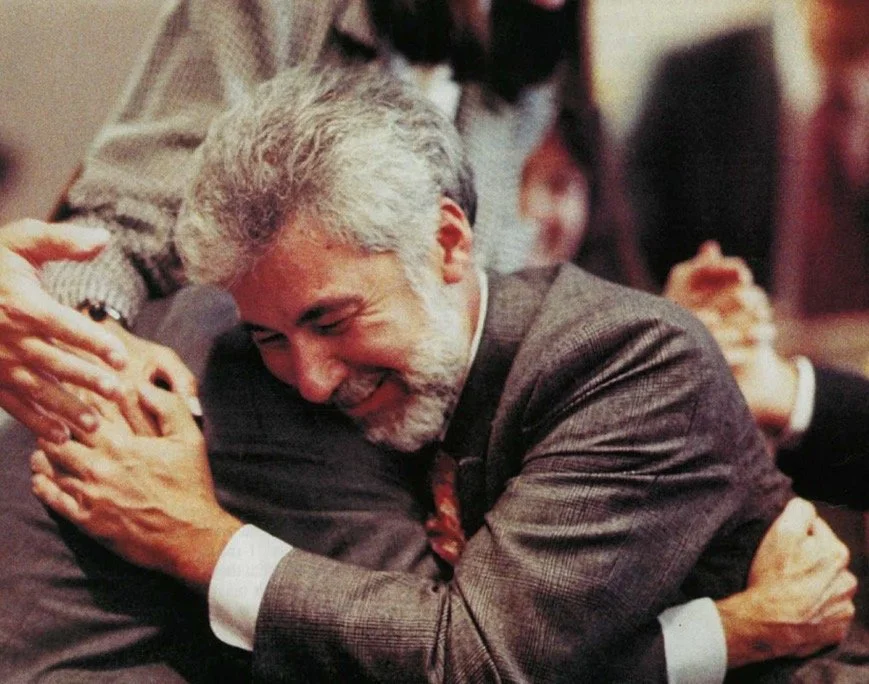
Dennis Barrie embracing his lawyer,
H. Louis Sirkin, after learning of his acquittal. If he had been convicted, says Barrie, "people would have attempted this all over."